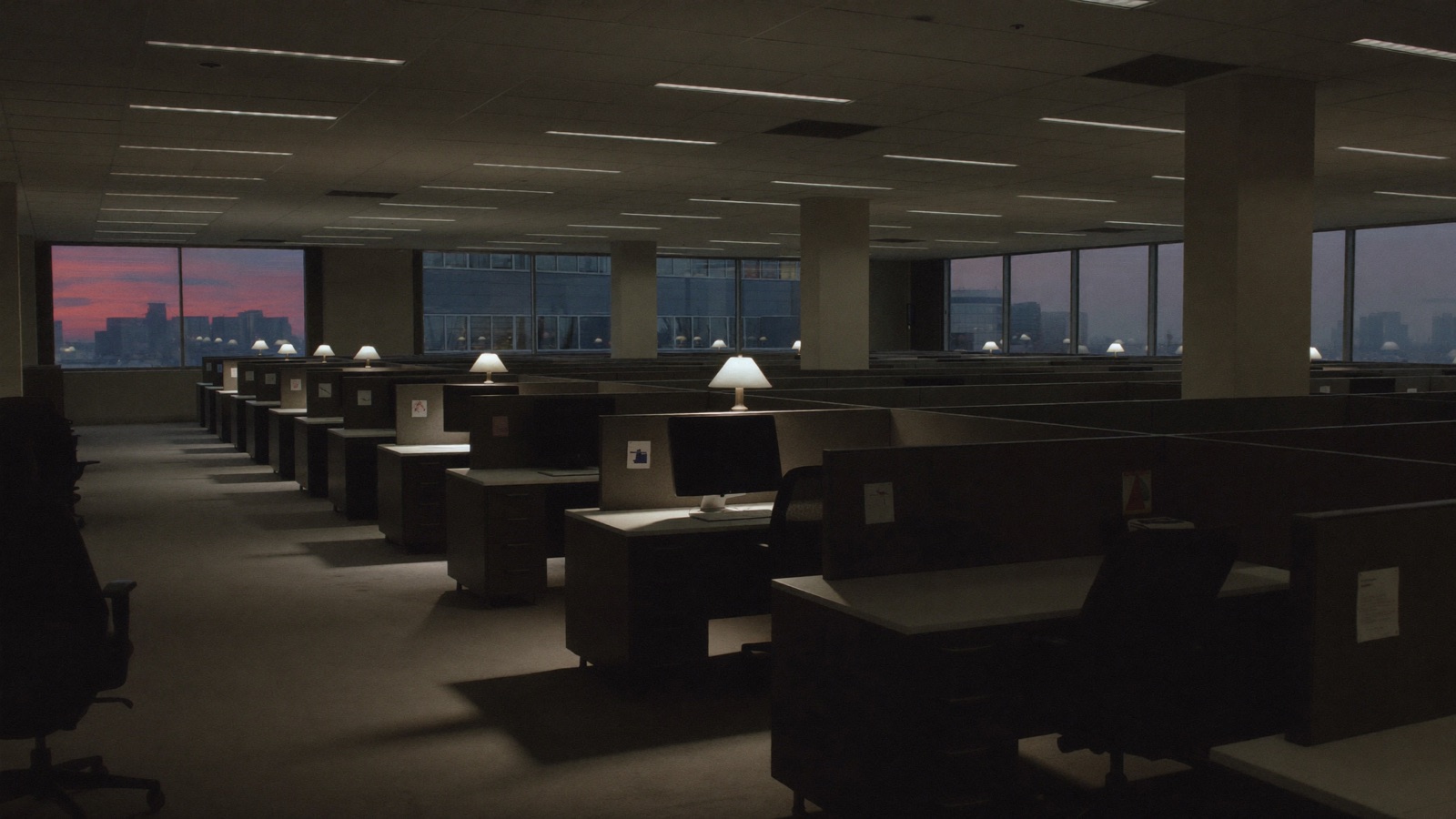
The biggest problem in the digital workplace is that nobody is in it
We have channels, boards, docs and calls. What we do not have is anywhere to be. Presence is the missing primitive, and most tools fake it.
Ask a remote team where they work and they will name their tools. Slack, Notion, Figma, Zoom, Linear. Ask them where they are and they will look at you strangely, because the honest answer is: nowhere in particular. They are at a desk, in a house, looking at a screen with a dozen tabs on it, and not one of those tabs is a place.
This is the problem underneath every other problem in the digital workplace, and almost nothing addresses it directly.
The green dot is a lie we agreed to believe
Most tools have a presence indicator. A green dot next to your name: "active". It is meant to answer the question is this person around?, and it does not, for three reasons.
First, it is binary. Around doing what? In a meeting? Heads-down on a deadline? Chatting with someone? Away from the desk but the laptop is open? The dot says green for all of these, so it says nothing about the one thing you wanted to know, which is can I talk to them now.
Second, it is private. You can see one person's dot at a time, by looking them up. You cannot see the room — who is around, who is busy, who is talking to whom. The information that lets you make a judgement about the whole team is scattered across a hundred profile hovers.
Third, and worst, people learned to game it. Mouse jigglers exist. "Away" is a signal you send to be left alone. The dot became a performance rather than a fact, and once a signal is performed it is worthless.
So we have presence indicators everywhere and no presence anywhere.
What presence actually is
Here is what an office gave you, without anybody designing it: a continuous, ambient, honest answer to what is going on. You walked in and saw it. Half the team at their desks. Two people at the whiteboard. Somebody on a call, door shut. Somebody clearly free and slightly bored. You took all of this in without reading a single word, and you used it a hundred times a day to decide who to ask, when, and how.
That is presence. Not a dot — a field. It has three properties the dot does not:
- It is spatial. Where people are tells you what they are doing. Two people close together are talking. Somebody at the edge is heads-down.
- It is continuous. It updates every moment, not when somebody remembers to change their status.
- It is mutual. Everybody sees the same room. There is no version of the office where you can see me and I cannot see you.
Remove any one of those and you are back to the dot.
Why every tool faked it instead of building it
Because building it is hard and faking it is a checkbox.
Real presence means every person's position has to reach every other person, continuously, at a rate that feels alive. That is a fan-out problem that grows with the square of the room. It means a server that holds the room's state as a single source of truth rather than a database that gets polled. It means handling the person whose laptop lid just closed without making them vanish or leaving a ghost behind. It means a client that draws a hundred moving things at sixty frames a second without eating the battery.
A green dot is a boolean in a user record.
The tools that did try — the "virtual office" category — mostly got the spatial part and missed the rest. They built a floor plan and asked you to walk your avatar to a meeting room, which is a meeting with extra steps. Presence was a feature of the map rather than the reason for the product, and when the novelty wore off people went back to the dot.
The bet we are making
Huddles is built on the opposite assumption: presence is the product, and everything else is what you do once you can see each other.
The space is a field. Everyone who is around is on it, as a floating avatar, drifting a little so it never looks like a screenshot. Two people talking are visibly merged. Somebody who has gone quiet is faded. Somebody who wants to be left alone goes private and disappears from the field entirely — an honest signal, not a performed one, and one that costs you something to send, because it means you cannot see anyone either.
You do not walk anywhere. There is no floor plan. You drag onto somebody and you are talking. The map is not the point; the seeing is.
What changes when people can be somewhere
We keep seeing the same thing in teams that adopt it, and it is not what the feature list would predict.
They ask more small questions. They schedule fewer meetings, because a lot of meetings were just a way to guarantee somebody would be there. Their chat gets quieter, and better. New people come up to speed faster, because they can see who to ask instead of being told. And the people who were lonely — more of them than anyone admits — are less lonely, because there is a difference between a list of names and a room with your people in it, even on a day when nobody talks.
None of this is a feature. It is what happens when the workplace has a where again.
The uncomfortable part
Real presence is also honest presence, and some people are not ready for that. If your team is used to the green dot as a curtain, a field where everybody can see everybody is going to feel exposed for about a week.
Then it feels like an office. The good kind — the one where you could turn your chair around.