The third space: why you need a room, not another meeting
Chat is where things are written down. Meetings are where things are decided. Nobody built the place in between — where you just talk.
Every team has two rooms and needs three.
The first room is chat. Slack, Teams, Discord — it does not matter which. It is the place where things get written down: decisions, links, the thing somebody needs from somebody else by Thursday. It is asynchronous by design, and that is its whole virtue. You can leave and come back. Nothing happens to you while you are away except that it piles up.
The second room is the meeting. A calendar entry, a link, a grid of faces, an agenda if you are lucky. It is synchronous by design, and that is also its whole virtue. Everyone is there, everyone hears the same thing, and something gets decided because there is a clock on it.
Here is what neither room does: it does not let you lean over.
The thing you lost when the office went away
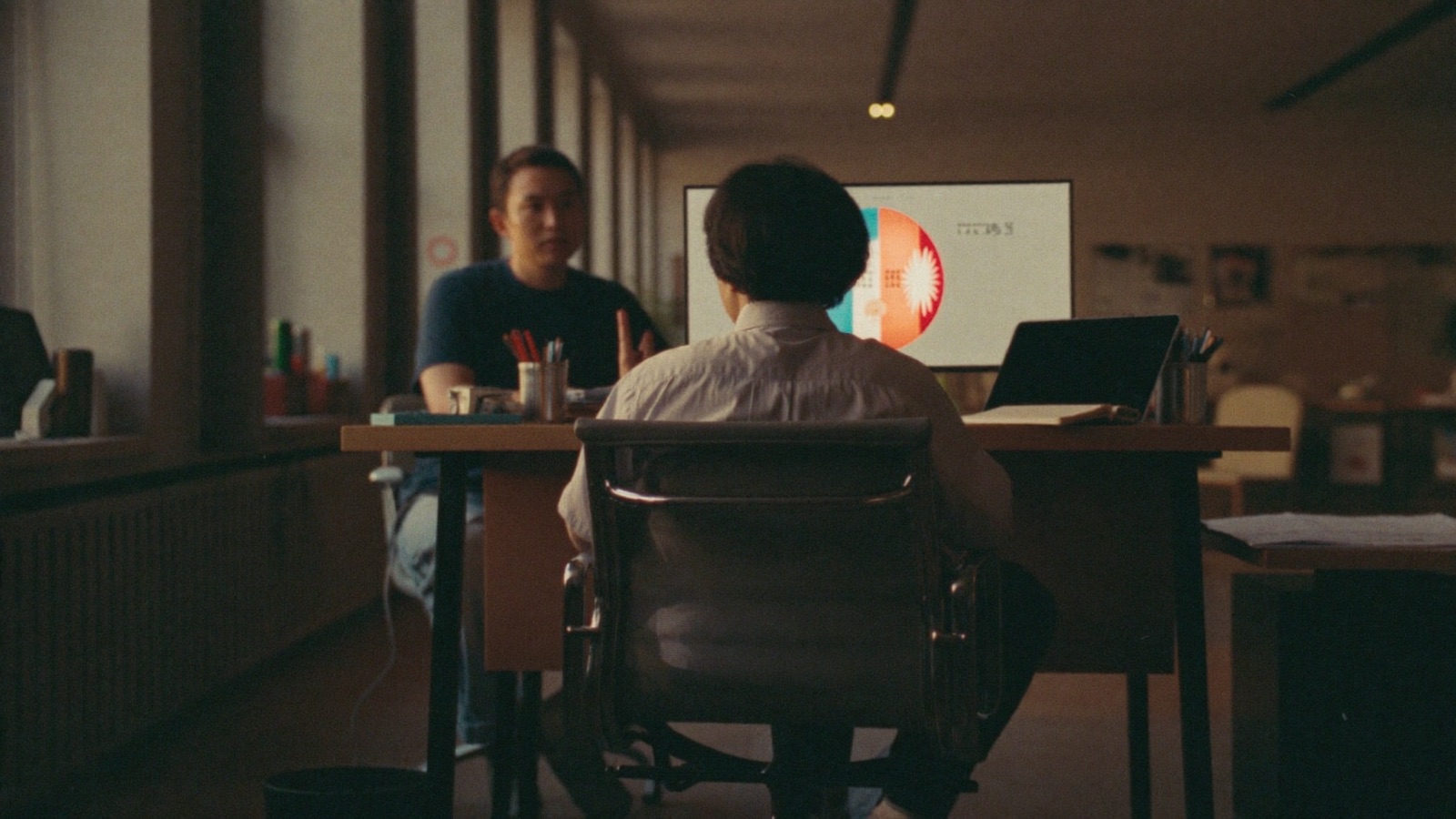
If you have ever worked in a physical office — even a bad one — you know the move. You have a question. It is not a big question. It is a forty-second question, but it will take you twenty minutes to write it down properly, and the answer will take somebody else ten minutes to write back, and by then you will have a follow-up. So you turn your chair around. "Hey, quick one." Ninety seconds later you are both back to work.
That move is the third space. It is not chat, because you did not write anything down. It is not a meeting, because nobody scheduled it and there was no agenda and it was over before a calendar could have noticed. It is the thing in between: quick, spoken, and gone.
Remote work did not kill collaboration. It killed that. And then it papered over the loss with two things that were never designed to replace it — a chat message that has to be composed, and a meeting that has to be booked.
Why the substitutes fail
Try it in chat. You type the question. You wait. The person is in a meeting, or heads-down, or just did not see it. Forty minutes pass. They answer, but they answered the question you asked and not the one you meant, so you clarify. Another twenty minutes. This is the same forty-second conversation, spread across ninety minutes of both of you being slightly interrupted. Nobody would design this on purpose.
Try it as a meeting. "Got fifteen minutes?" You find a slot — tomorrow, 2:30. You both put it in the calendar. You both show up. You both join the call, wait for it to connect, say hello, ask the forty-second question, get the answer, and then sit in the awkward space where the meeting is over but the slot is not. This is the same conversation with a twenty-four-hour delay and a ceremony attached.
Both substitutes cost more than the thing they replaced, and — this is the important part — the cost is paid up front. You have to decide the question is worth a message, or worth a meeting, before you ask it. So the small questions simply do not get asked. They become assumptions. Assumptions become rework. Rework becomes the Friday retrospective where somebody says "I didn't realise you meant..."
What the third space actually needs to be
We have spent a long time thinking about what makes the office move work, and it is not the office. It is four properties.
It is quick. The time from wanting to talk to talking has to be seconds, not minutes. No link to find. No dial-in. No "let me just share my screen — can you see it? no? hang on."
It is audio-first. Turning your chair around does not require you to be camera-ready. Voice is the lowest-friction, highest-bandwidth channel humans have, and it does not care whether you have brushed your hair. Video is a wonderful thing to add; it is a terrible thing to require.
It is lightweight. Nothing is created that has to be cleaned up afterwards. No recording sitting in a drive. No calendar entry to decline. No thread to mute. When the conversation is over, it is over.
It is ambient. You can see that the other person is there before you ask. That is what makes the ask cheap: you already know they are around, you can see whether they are already talking to somebody, and so you know whether now is a good time. That single piece of information — is it a good time — is the thing every remote tool throws away.
So we built a room
Huddles is our attempt at the third space, and it is built from exactly those four properties and not much else.
You are in a space. You can see it — a field of floating people, drifting a little, each one somebody who is around right now. You can see who is already in a conversation, because they are merged into a huddle with somebody. When you want to talk to someone, you drag yourself onto them. That is the whole gesture. You are now in a huddle, on voice, with a whiteboard and a document a click away if you need them and completely out of sight if you do not.
When you are done, you leave. Nothing was recorded. Nothing was scheduled. Nothing needs to be tidied.
We resisted, hard, the urge to make it more than that. It would be easy to add a calendar and turn every huddle into a meeting. It would be easy to add threads and turn every huddle into a chat. The product would look busier and demo better. It would also stop being the third space, and become a worse version of the two rooms you already have.
And none of this is a workplace thing, though the office is where most of us learned the move. The third space is the foyer after the service, where the conversations the sermon started actually happen. It is the hackathon table at two in the morning, where "hang on, look at this" is the whole method. It is the hallway track at a conference, the study group between classes, the five minutes after band practice. Anywhere people gather, the small unscheduled conversations are the fabric — and they are exactly what every digital room so far has failed to carry.
The test
Here is how you know whether a tool is the third space or a new coat of paint on the old two.
Ask yourself: how long does it take to ask a forty-second question? Not the time to get the answer — the time to ask. If the answer is "I have to write it down" or "I have to find a slot", it is not the third space. If the answer is "I look up, see they are around, and say it", it is.
That is the bar. It is a low bar in the physical world and an almost impossibly high one in the digital one, which is why most teams have simply stopped asking the small questions. We think that is the quietest, most expensive loss of the last five years, and we think it is fixable.
Turn your chair around.