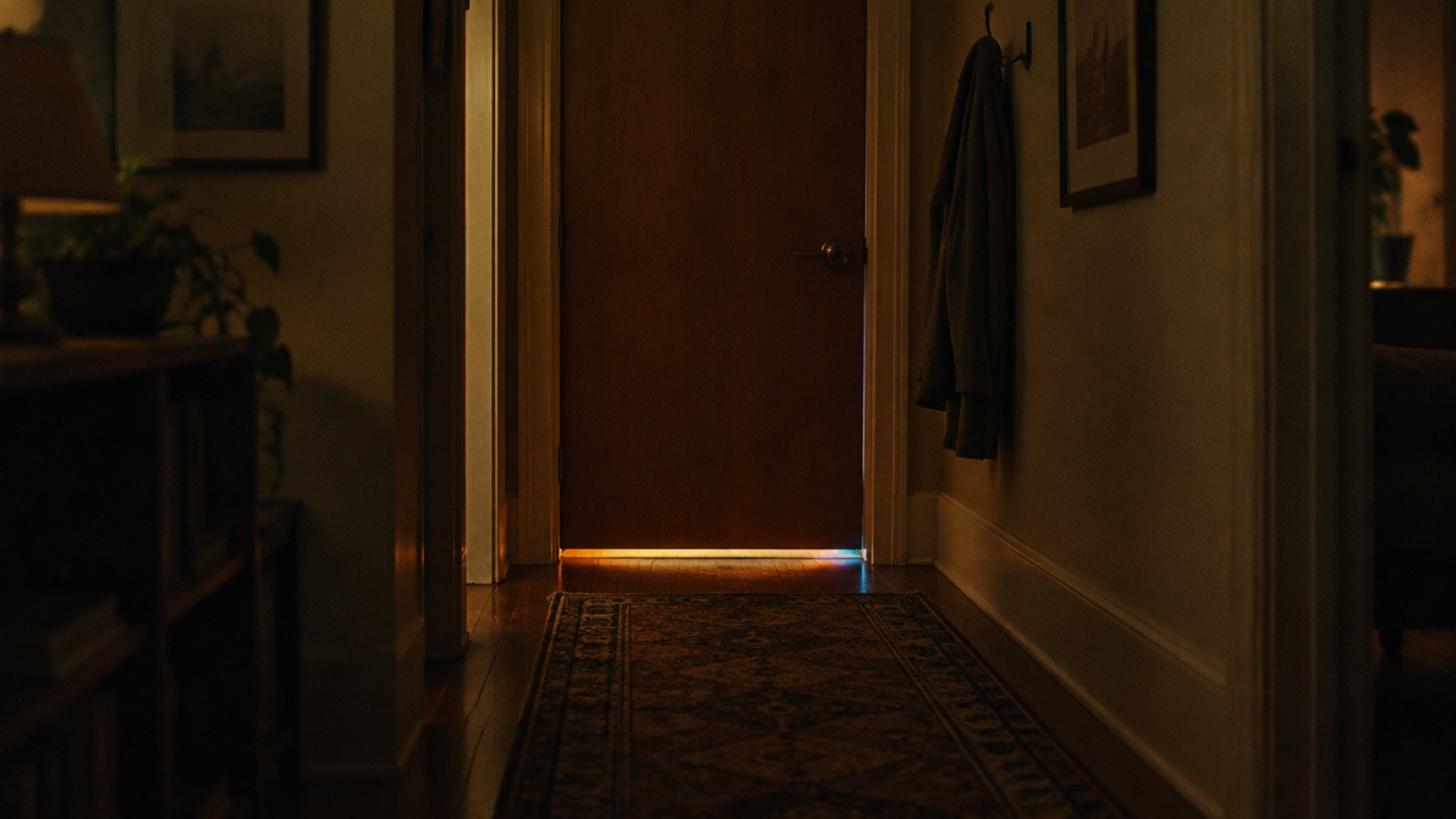
The closed door
Why we tell a screen what we would not say across a table, what a Cornell experiment found about who we decide it was meant for, and what a room should do with what it hears.
Think about the last genuinely personal thing you told somebody. There is a fair chance you typed it. Late, probably, from your own bed or your own desk, with nobody else in the room, to one person who was, as far as you knew, alone too.
That is not a failure of modern friendship. It is one of the steadier findings in communication research: people disclose more, and more intimately, through a screen than across a table. What gets talked about less is the other half, and it is the half we keep thinking about. We do not only say more online. The same words land harder.
The experiment
In 2011 three researchers at Cornell — L. Crystal Jiang, Natalie Bazarova and Jeffrey Hancock — published a tidy experiment that pulls those two halves apart.
Seventy-nine students were each paired with what they took to be another student. She was a confederate, trained for twenty hours to say the same things the same way every time. The task was harmless: agree on ten tips for surviving the first year of college. Half the pairs sat together in a room. The other half talked over AOL Instant Messenger from separate rooms.
The trick was in two of her tips. For half the participants they came with ordinary reasons: freshmen put on weight, exercise relieves stress. For the other half, the same tips came with something personal. She had gained twenty pounds on dorm food and somebody had asked if she was pregnant. Her parents were divorcing that year, she was ill for a week, and yoga was what got her through.
Because her words were scripted, the speaker was held still. Whatever changed had to be in the listener.
What they found
When she kept it impersonal, the medium made no difference at all. People felt exactly as close to her in chat as in person.
When she opened up, everybody felt closer — but the people reading her words in a chat window felt much closer. The lift from the same disclosure was about twice as big in text as it was across the table.
Then comes the part that makes the paper worth reading. The researchers asked everyone why they thought she had shared what she shared, and scored the answers three ways:
- Dispositional: she is just an open person.
- Situational: it is the medium, and people say things in chat.
- Interpersonal: she said it to me, because of something between us.
Only the third explained the gap. Once you account for how strongly people believed the disclosure was about the two of them, the extra effect of chat stops being significant. It was carried, entirely, by that one belief. The intimacy of text was not in the words. It was in the reader's answer to a question the authors put in plain English: why did she share that with me?
This is what the communication scholar Joseph Walther called the hyperpersonal effect. With fewer cues to check against — no face, no tone, no sense of how she talks to everybody else — people fill the gap with the warmest explanation going. It was for me.
Where we think something is missing
We agree with the paper. We also think it opens a conversation rather than closing one, and the authors say as much: their pairs were strangers with no expectation of meeting again, both confederates were women, and the next question they wanted answered was what a listener does with a disclosure afterwards.
The gap we keep returning to is in the attributions themselves.
Read the table rather than the headline. In chat, after the personal disclosure, people did not simply pick the flattering explanation over the others. They leaned harder on the explanations in general. Most of all, they rated it is the medium far higher than the people across the table did — and believing it did not make them feel one bit less close. The explanation that was supposed to cheapen the disclosure simply did not.
The authors are careful with that number, because it came from the least reliable measure in the study, so treat what follows as a hunch rather than a result. But it is a hunch with an old, physical version.
A closed door
Picture a party. Two friends slip out of the kitchen into a bedroom and close the door. What gets said in there is, in the paper's terms, situational: it is being said because the door is shut. Nobody would say it by the fridge. And yet nobody in that bedroom thinks the closed door makes the conversation cheaper. The door is the point. Being asked into the room is the interpersonal part.
That, we think, is what a private conversation on a screen feels like, and it is why people share more there. Not because the internet is anonymous — most people in a direct message know exactly who they are talking to — but because the space comes with a closed door built in. Nobody walks past. Nobody overhears. The audience is known, it is small, and you chose it. The comfort people feel online is not a failure to judge risk. It is a correct reading of the room: this one has a door, and it is shut.
So it is the situation and it is about us are not rival explanations. In a closed room they are the same sentence. A study that scores them as competitors will find that the medium does not explain the intimacy, when the medium may be the reason the intimacy could happen at all.
We would love to see someone test that properly, and ask not only why did she tell me but what kind of room did this feel like.
What the room keeps
There is a second thing a closed bedroom door does that a digital one usually does not. It forgets.
What is said at the party exists afterwards in two memories, both imperfect, both fading. What is said in a direct message exists in an archive. The message you sent at two in the morning three years ago is still there, scrollable, searchable, word for word. So is everything anybody ever told you.
That changes the economics of staying. Part of what keeps people on a platform is that it holds their history: the threads, the photos, the versions of themselves they gave to somebody. Leaving means leaving that behind, so leaving is expensive, and platforms know it.
And the archive cuts the other way too. You are holding other people's disclosures as well — the screenshot, the quoted line, what the internet, accurately, calls receipts. A closed door that keeps a transcript is a strange kind of door. Everyone inside it is also, quietly, a witness.
The answer is not that nothing should ever be kept. People want their notes, their boards, the document they wrote together. We think the answer is that the room should not be the one keeping it.
What we do with this
Huddles is a room, so for us these are design questions rather than abstract ones. Here is where we have landed.
A huddle can close its door. Make it private and the people outside see that a conversation is happening, nothing of what it is about, and no way in. That is exactly what a closed door shows from the hallway. If you want more than that, private mode takes you out of the space altogether.
The room forgets. The chat beside a huddle lives as long as the huddle does and goes with it. Captions travel from the speaker to the people in the room, and our servers write none of them down. Even the whiteboard and the document a huddle shares end with it, unless somebody keeps a copy. What lasts belongs to a person — their own boards, their own documents, the notes they chose to take — and they can export it and delete it.
Keeping is never secret. When somebody records a huddle, everyone in it sees a red timer with that person's name on it for as long as it runs. Nothing can stop a determined person copying a conversation. What a room can do is refuse to let it happen invisibly.
Mostly voice. This is where the paper stops helping us, because it tested text and we are mostly voice. A voice carries exactly the cues the hyperpersonal model says text is missing — tone, hesitation, warmth — so we would expect less of the inflated it was for me, and more of the real thing. Whether that makes a conversation less intimate or more honestly intimate is the study we would most like to read. Our bet is the second.
If people come back to Huddles, we want it to be because the people are there, not because we are holding their history.
The kind reading
The usual way to tell this finding is as a warning: online, people over-read each other. That is true. But there is a kinder reading. People are very good at noticing when a space is private, and they open up when it is. The job of anybody building one is to deserve that, with a door that really closes and a room that does not take notes on its own.